Lady’s Finger: Okra


~ February 15th, 2010. Filed under: Uncategorized.

There is no middle ground when it comes to eating okra; either you get it or you don’t get it. Professing you like okra because of its perfect ridge and tapering ends (where I think the name lady’s finger originated) does not make sense. You have to like the totality of this plant—it’s not only its beauty but also its uniqueness that separates okra from the rest of the vegetables; its pearly white small seeds and most of all the gummy substance that gives okra its special character. One of my relatives eats cooked okra by slitting and scraping the seeds. Why? She says she hates the slime. What? She swears she likes okra.

Do you know that okra is native to Africa? In addition, do you know the name okra is an African name? It was first cultivated in Ethiopia or in W. Africa, and then spread to North Africa, Eastern Mediterranean, Arabia, and India. The migration of okra to the New World was the result of the traffic in slaves, arriving in America during the 17th century. From India, it spread to South East Asia then to China.

You will find the use of okra in America through Creole cookery and Cajun food. What is amazing is their use of the glutinous texture in their dishes. They never try to hide it. Slicing the pod is not enough; they still add, “file”, a powder made from sassafras to add more gumminess in their “gumbo soups”. In the south, they made okra fritters by adding cornmeal and deep-frying them. I have to add this, too: they pickle em’.

In the Philippines, they cook them as it is by just boiling them with a pinch of salt, like my mother’s way of simplifying her cooking; or they add them to “Pinakbet” or “Sinigang”.

India’s wealth of spices makes them creative in using okra in their dishes. Besides braising them with tomatoes, they also dry cook them by using oil and spices to prevent the so-called gummy-attack.

Let us talk about Europe. Have you seen Europeans eating okra? I have not seen one, sorry. However, somebody told me that this is widely eaten in the South of France and some parts of Spain.

Here is how I use okra in my everyday cooking at home and in the café:


Okra Phoran

2 tablespoons canola oil

2 teaspoons Panch Puran (a blend of Indian spices)

½ teaspoon fresh ginger, grated

1 green chili, chopped fine

4 cups okra sliced into 4ths, ends removed

1 teaspoon lemon juice

1 teaspoon brown sugar

Sea salt, to taste

  1. In a large skillet over medium heat, add oil and stir panch puran until toasted and brown for a minute.
  2. Add ginger and green chili; cook until chili is soft and ginger is brown, 2 minutes.
  3. Stir in okra, lemon juice, and sugar. Continue stirring until okra is brown and soft, 3 minutes.

    Taste and adjust seasonings.

  4. Normally, I serve it as a side dish, but I like it as an appetizer, too.


    “Pinakbetan”

    It’s a popular dish in the Philippines, but I digress from the true nature of the dish. I didn’t use fish sauce which is usually one of the main ingredients of this dish. Instead I used bean sauce, which is also available in oriental stores. Actually, replacing the fish sauce in this dish is one of the biggest “transgressions” vegetarians can commit in Filipino Cuisine.


    2 tablespoons canola oil

    1 teaspoon fresh ginger, grated

    2 medium tomatoes, chopped

    1 green chili, chopped

    ½ teaspoon asafetida or hing

    1 cup okra, ends removed and sliced into 4ths

    1 small eggplant, sliced in half moons

    ½ cup string beans, cut to 1 inch pieces

    1 cup calabaza or similar, sliced medium

    2 tablespoons bean sauce, or to taste

    ¼ cup water or more as needed

    Sea salt and black pepper, to taste


    1. In a large skillet or medium-size pot, heat oil and add ginger. Stir until golden brown for a minute.
    2. Add tomatoes, chili and hing. Cover and stir from time to time until the tomatoes are cooked, 2 minutes.
    3. Add the rest of ingredients. Cover and stir occasionally until vegetables are cooked but still firm, 3 to 4 minutes.
    4. Taste and adjust seasonings.
    5. Best serve with rice.

    Tip: optional

Add 1 cup of tofu or tempeh, cubed and deep-fried.
Didi Karuna – The Lotus Jewel of Ranchi


~ January 19th, 2009. Filed under: Ananda Marga.

Unassuming, delicate, exuberant, and yet exuding the finest love and devotion to Baba. These qualities express her great love of Baba by fulfilling her service to unending lines of patients in her hospital where her family resides, too. A loving mother, a willful wife, a compassionate doctor, and most of all an Acharya rolled into one; that’s Didi Karuna.
On the way to Ranchi, I happened to ask Didi Ananda Rupadhara (my “tour guide” in India) where we’re going to stay in Ranchi. Without any qualm, she simply replied, “in the hospital.” Did I hear it right, “hospital?” I’m not complaining, but is there anyplace better than the hospital? I’m just asking, well…
I like the room; it seems this room has been used by Didis or Dadas because of some paraphernalia left in the place. Umm, I liked the vibes.
The hospital is pretty big with lots of rooms. It’s owned and run by Didi Karuna. They reside upstairs and we stayed on the second level.
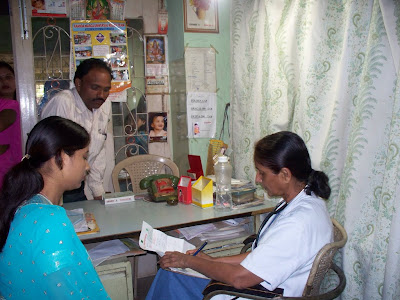
Didi Rupadhara introduced me to her the next morning in front of her numerous patients. I was so mesmerized by her persona. Why don’t I know this great lady? She’s definitely a well-kept secret saint of Ananda Marga. Baba must have a reason why He shielded her from this materialistic world. Ranchi and India needs her. She works tirelessly everyday till night, even on Sunday. The picture posted above was taken on Sunday morning while she’s surrounded by her patients. And on that night during the dharmacakra in Baba’s Quarter, she was there with her loving husband. I’m sure she was tired that night but she still had time to attend DC (anybody who’s on the fence about not attending DC, you better think twice). She’s beautiful in and out.
It’s so awkward to ask if I can have a short conversation with her because I knew she’s that busy, but I’m leaving the next day. Anyway, the next morning as soon as I finished my sadhana, their housekeeper came summoning us to go upstairs. Didi Karuna wants to talk to us. “Hurry up Didi, c’mon let’s go.” The housekeeper ushered us to their meditation room. It looks like she just finished her morning sadhana. She invited us to sit in the chair outside and she took another seat beside Didi. This was the first moment I can say I had a chance to see her face to face. She’s breathtakingly beautiful with a gorgeous aquiline nose. I can’t guess her age. Her parents are devotees of Baba. It was Baba who gave her name. She she even got a chance to take care of Baba when He was sick.
The most profound story she narrated was when she was called, together with another Margii doctor, to resuscitate Baba on that day in October 1990 when He was found motionless in His room. In spite of the fact of the gravity of the situation, she was able to control her composure. They tried everything they knew but still Baba wasn’t breathing. There was one thing that they hadn’t done, mouth to mouth resuscitation, which she did kindly and respectfully. But on that day, even doctors couldn’t help.
I asked her if she could give me a little bit of cut toe nails from Baba that she kept in her locket. Although she replied affirmatively, she was called right away by her duties and we had to hurry up to catch our train to Ananda Nagar. Well, it seems I have a reason to go back to Ranchi.

Dada Vishvadevananda, The New Purodha Pramukha


~ January 17th, 2009. Filed under: Ananda Marga.

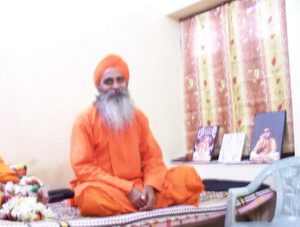
admin-ajaxI want to start with the first picture of the second newly elected Purodha Pramukha and President of Ananda Marga (AMPS), Ac. Vishvadevananda Avadhuta. He’s young, tall, and I must say dashing. He must be in the middle of 50’s. He replaces Rev. Ac. Shraddhananda Avadhuta who passed away on the 15th of October, 2008 in Ranchi at the age of 92.
Fortunately, I was introduced to new PP when we visited Ranchi, the headquarters of AMPS. The only thing I remember during that brief encounter was his question, “how’s your trip?” I can’t remember my answer, I’m that nervous believe me. He’s on his padmasana on his bed as his cot while I’m on the floor staring at him. Although I don’t recall having met him or hearing his name before, my salutation and respect for him doesn’t diminish a bit. He has served as the Acting General Secretary of Ananda Marga since 2003; became a Sannyasi(monk) in 1972 ( btw, I was initiated the same year, too); and has served in different capacities including Mahasachiv of Ananda Marga Gurukul University at Ananda Nagar.

In his address after the announcement of his election as Purodha Pramukha, he encouraged all of us devotees and Acaryas to work in harmony and united to serve the suffering humanity. He reminded us the comprehensive, multi-demensional philosophy of Baba, Shrii Shrii Anandamurtijii as an antidote for deep problems faced by the world today. He emphasized our responsibilities to respond to challenges our humanity is facing in all walks of life.

Welcome


~ December 14th, 2008. Filed under: Uncategorized.

1-3-2007-6-56-59-pm_0298

Welcome to my blog.  My name is Jyoti and I’m starting a blog where I can talk about my devotional experiences in Ananda Marga.  I’ve just returned from a very inspiring visit to India and I’ll relate here many of the experiences I had there and the stories I heard.  There will be lots of photos too.